
The latest release from Jason August, multiple performers and multiple styles. Available on all music streaming services. Just search “casual soup”
The latest release from Jason August, multiple performers and multiple styles. Available on all music streaming services. Just search “casual soup”
Friends, I know I don’t post as much as I should here. I spend most of my time at work and any free time with my family. I found over a recent trip to Africa and another trip to the UK time to reread Strauss’ and Howe’s book “The 4th Turning”. Then I went skateboarding this evening (always cleans the mind and soul for me). Had to type out my thoughts.
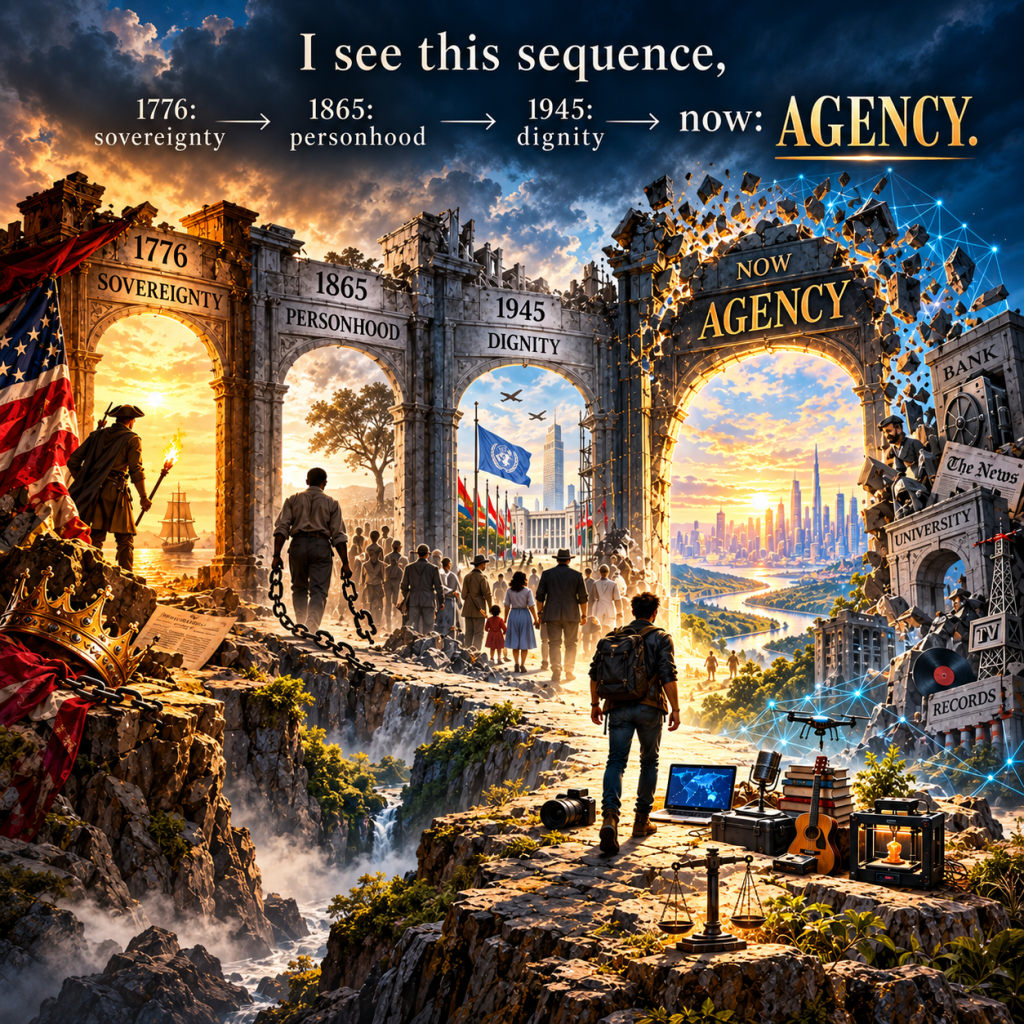
Will the 4th turning of this cycle be the: The Death of the Gatekeeper?
If we accept Strauss and Howe’s, Fourth Turning not as prophecy but as a useful lens, the pattern is striking: roughly once in a human lifetime, a crisis destroys an assumption/paradigm that had seemed permanent and replaces it with another. Strauss and Howe identify the Revolution, Civil War, and Depression/World War II as America’s great Crisis eras.
A perspective: each crisis isn’t merely political. It changed the definition of the individual.
1776 said: You do not belong to a king. The individual could possess their own sovereignty.
1860s said: One human being cannot belong to another. The individual could possess themself.
1940s said, imperfectly and absolutely incompletely: Human dignity cannot depend upon race, blood, nation, or inherited status. The postwar order increasingly made universal human rights–not merely citizenship–the moral language by which governments were judged.
So what dies next?
I suspect it’s the gatekeeper.
For most of modern history, individuals have required institutions to exercise meaningful power. Banks determined whether your idea received capital. Publishers determined whether you could reach readers. Record companies determined whether anyone heard your music. Universities certified knowledge. Newspapers determined what became public information. Governments issued currencies. Corporations owned the machinery necessary to manufacture things.
The internet began weakening this superstructure. Artificial intelligence will likely finish the job.
The next turning may therefore be about something deeper than left versus right, nationalism versus globalism, or capitalism versus socialism. I hypothesize it will concern individual agency versus institutional mediation.
A person can increasingly create music without a record company, publish without a publisher, manufacture without owning a factory, learn without attending a university, broadcast without owning a television station, build software without employing fifty programmers, and potentially conduct economic activity through networks that do not resemble twentieth-century banks.
This thought is enormously liberating and completely in every way, terrifying:
Institutions aren’t merely gatekeepers. They are filters. Editors reject nonsense. Banks absorb certain risks. Universities establish standards. Governments authenticate identities. Journalists decipher facts. Sometimes, so many times those institutions abuse their authority–but they also created a shared reality within which millions of strangers could cooperate.
So perhaps the coming crisis asks a more important question:
What happens when everyone becomes sovereign before we’ve figured out how sovereign people establish trust with one another?
The Revolution democratized government.
The Civil War ultimately democratized personhood.
The postwar settlement increasingly democratized dignity.
This turning may democratize power itself–the ability for a ordinary human to create, communicate, organize, persuade, manufacture, and participate at a scale once reserved only for institutions.
This thing being born may also resurrect something very old:
RESPONSIBILITY!
If there is nobody standing between the individual and enormous technological power anymore–we can no longer blame the king, the master, the institution, the editor, or the machine.
The strange destination of four centuries of self-determination may be discovering that the final burden of freedom is having no one left to hand your agency to. It’s yours, just yours
Perhaps, that would be a Fourth Turning worthy of the name.
Strauss and Howe themselves were careful about one important point: their framework proposed the rhythm and magnitude of crises more confidently than any prescribed outcome.
History doesn’t have to choose a particular future.
I see this sequence, 1776: sovereignty → 1865: personhood → 1945: dignity → now: AGENCY.
Would love some comments, did I miss the mark? If you’ve gotten his far lets chat…
Link to the book on amazon, was a great read:
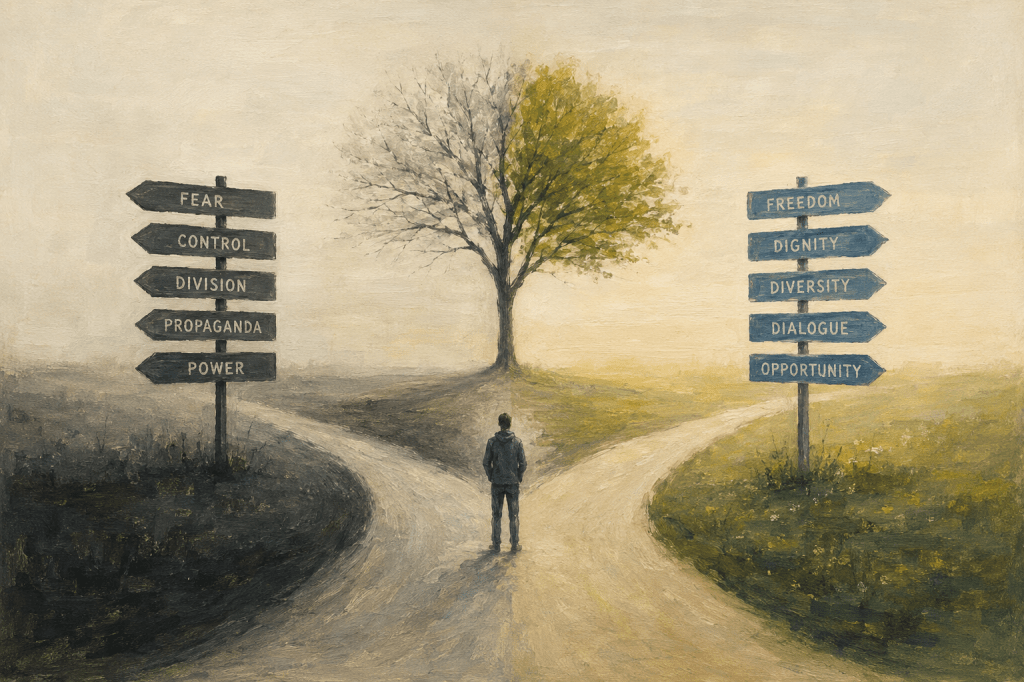
An essay by Jason August on the fundamental differences between Communism and Liberal Democracy framed around the use of active measures to undermine the beauty of liberal democratic systems.
I started thinking this evening about Soviet Active measures (aktivnye meropriyatiya) after reading Tomas Rid’s book of the same name, a few months ago. My questions underneath the thoughts turned out to be much larger.
Why would a state attempt to sell, or even indirectly impose upon others, a system that was visibly failing within its own borders? At what point did Soviet leaders understand that the society they had built did not resemble the society they claimed or desired to have built? Why, once they understood that, did they continue trying to convince the world that their system was superior, or did something darker happen? Did the objective gradually change from believe what we believe to how do I stop you from believing in what you believe?
That question led me backward, toward the premise underneath the Soviet experiment itself.
The Soviet project was not simply an attempt to redistribute wealth. At its most ambitious, it attempted to change the material relationships among people.
That distinction matters.
Marxism proposed that much of what we think of as human behavior is produced by material circumstances. Owner and worker, landlord and tenant, rich and poor, creditor and debtor—these relationships do not merely distribute resources. They shape the people living inside them. Competition, alienation, exploitation and class consciousness arise, at least substantially, from the organization of material life.
Change those relationships, therefore, and perhaps we change ourselves.
There is something compelling in that idea because some portion of it is obviously true. Human beings behave differently under different incentives. Scarcity changes behavior. Abundance changes behavior. Institutions shape expectations. Culture establishes what is honorable, shameful, ordinary or unthinkable. A child born into a feudal society understands his possibilities differently from one born into a modern liberal democracy.
But the Soviet experiment encountered a problem… Human beings came with it.
Eliminate private ownership and people still seek status. Suppress markets and exchange does not disappear. Remove wealth as the principal currency of privilege and access itself becomes valuable. Political position becomes a kind of property. Relationships become a kind of market. Proximity to power becomes capital.
The hierarchy did not disappear.
It changed currency.
That realization leads to a question that extends far beyond communism:
How much of the human being is created by the system, and how much of the system is created by the human being?
Every political and economic system develops a distance between what it claims to be and what the people operating it know it actually is. That is not uniquely Soviet. Corporations do it. Governments do it. Militaries do it. Religions do it. Liberal democracies do it.
The people nearest the machinery almost always understand its contradictions better than the people looking at the machinery from outside.
What made the Soviet contradiction particularly severe was the magnitude of its claim. The system did not merely promise better government. It claimed to have identified the historical forces producing exploitation and hierarchy and to possess a means of overcoming them.
Yet hierarchy returned.
Privilege returned.
Self-interest returned.
Favoritism returned.
Parents still wanted advantages for their children. Officials still wanted better apartments. People still wanted security, recognition, comfort, influence and access.
The revolutionary may have believed that he was sacrificing himself for a society that had not yet arrived. The next generation could tell itself that the system was imperfect but worth defending. Eventually another generation could simply understand how the machinery worked and make the accommodations necessary to live inside it.
Perhaps nobody needed to announce:
We don’t believe anymore.
Belief could simply become ritual.
Attend the meeting. Repeat the language. Display the symbols. Produce the numbers. Protect your position. Help your family. Don’t ask questions whose answers everyone already understands.
This is where the Soviet story becomes more interesting to me than the simple declaration that “communism failed.”
Perhaps the deeper failure was mistaking a theory of human behavior for a theory of human nature.
Material conditions unquestionably influence us. But the Soviet experiment suggests that there are persistent human impulses capable of surviving enormous changes in material conditions. Ambition, loyalty, envy, generosity, greed, love, tribalism, fear, competition, status-seeking and the desire to give our children advantages do not necessarily disappear when the economic vocabulary surrounding them changes.
They find another outlet.
And the cost of discovering this was not academic.
Millions of people died under the Soviet system through political terror, execution, forced collectivization, famine, deportation, imprisonment and the Gulag. Any examination of the Soviet experiment that becomes fascinated with the theory while allowing those people to disappear into abstraction commits another kind of error.
Because there was a terrifying possibility contained within the attempt to remake society.
Begin with:
Human beings are shaped by their circumstances.
Move to:
We must change their circumstances.
Then:
Some people are preventing that transformation.
And eventually:
Those people are standing in the way of history.
Once human beings become obstacles to an imagined historical destination, extraordinary cruelty can be reframed as necessity.
That progression was not philosophically inevitable, but historically it happened.
And after all that coercion, the new human being still did not arrive.
People rebuilt hierarchies.
They created informal markets.
They accumulated privileges.
They cultivated relationships.
They protected their families.
They pursued status.
The state could change the rules governing human interaction, but it could not simply manufacture the human being its theory required.
That brings me back to active measures.
What happens when the people operating such a system begin to understand its contradictions?
Early revolutionary ideology could genuinely proclaim:
Our system represents the future.
But maintaining that confidence becomes increasingly difficult when the people making the proclamation can see shortages, privilege, corruption and stagnation around them.
At some point the easier argument becomes something different:
Your system is fraudulent too.
That is an extraordinarily important transition.
You no longer need to convince an American that Soviet communism is superior. You only need to convince him that his own institutions are illegitimate.
Find the genuine contradictions.
America has plenty.
Race. Wealth. Inequality. War. Political corruption. Hypocrisy. Corporate influence. Class. Religion. Immigration. Regional differences.
You don’t necessarily have to invent the wound.
You can simply keep touching it.
And perhaps this is where the psychology of the late Soviet system becomes relevant. A ruling class that had watched belief deteriorate inside its own society would have possessed intimate knowledge of something extraordinarily powerful:
Institutions depend upon people continuing to believe that participation is worthwhile.
That lesson survives communism.
Modern authoritarian influence does not necessarily need to offer an alternative political philosophy. It can accomplish something by producing exhaustion, cynicism and distrust.
Everyone lies.
Everything is corrupt.
Nobody earned anything.
The system is rigged.
Nothing you do matters.
There is no truth, only competing narratives.
That is different from saying become like us.
It says:
Stop believing you can be different from us.
And here is where liberal democracy has to resist the temptation to congratulate itself.
Capitalism and democracy do not and cannot solve the problem of human nature either. Wealth becomes power. Institutions protect themselves. Markets become captured. Families transmit advantage. Bureaucracies perpetuate themselves. Successful people can mistake the advantages they received for evidence of merit. I typed that through a giggle.
Our hierarchy can change currency also. The difference worth protecting may therefore be more modest than claiming that we discovered the perfect system.
Perhaps the achievement of liberal democracy is that it does not require a perfected human being.
It assumes that people will seek power and therefore divides power. It assumes that leaders may become corrupt and therefore makes them removable. It assumes disagreement will persist and therefore creates mechanisms for disagreement that do not require eliminating the person on the other side. It allows property but attempts to constrain what property can purchase politically. It protects individual ambition while acknowledging that one person’s ambition can threaten another person’s liberty.
It doesn’t eliminate the human problem. At its best, it contains the human problem.
And perhaps individual opportunity is more important psychologically than I had previously considered. A person does not have to become wealthy to believe that his choices matter. He needs some credible reason to believe that his position is not completely predetermined—that he can build something, leave something, criticize something, change professions, create, fail, recover, move, speak, dissent, or give his children possibilities he did not possess.
The opportunity may be imperfect.
It may be distributed unfairly.
But belief in agency matters.
Which makes the most effective attack upon such a society surprisingly simple.
Don’t convince people that dictatorship is better.
Convince them that agency is an illusion.
Convince them that elections don’t matter, institutions cannot be repaired, achievement is fraudulent, truth cannot be discovered, everybody is corrupt and every apparent ideal is merely camouflage for somebody else’s pursuit of power.
Eventually people stop defending the imperfect institutions that allow them to change things because they have been persuaded that changing things is impossible.
And that brings the entire thought back to the human being.
The Soviet project tried to change material relationships in order to change humanity.
It discovered, brutally, that humanity also recreates material relationships in its own image.
Liberal democracy makes a different wager: don’t wait for better humans. Build institutions capable of surviving the humans we already are.
But that system contains its own vulnerability.
It survives only while enough imperfect human beings believe that, despite its contradictions, they retain some ability to act within it.
So perhaps the deepest contest was never communism versus capitalism.
Perhaps it was between two ideas about the relationship of the individual to the system.
One believed that changing the system could eventually transform the human being.
The other, at its best, assumes the human being will remain stubbornly human and tries to prevent any one of us–or any group of us–from gaining enough power to decide what everyone else must become, love, do, believe, etc….
That is a much less utopian promise.
After the twentieth century, I am beginning to think that may be precisely its virtue.
These two songs are really about the same person, just viewed from different points in life and through different emotional lenses. Is it fiction? Is it based on real life events? Who could know?
In the first song, we see her years later. The decisions were already made. The roads already taken. What remains is the weight of choice and the quiet grief that comes from realizing life doesn’t always give us the timing we want or need. Sitting staring through a rain-streaked windshield, asking a question most people eventually ask themselves: When is it our turn? When do I get to live for myself? When do I stop being who everyone else needs me to be? The song is about love, but it’s also about sacrifice, obligation, and the loneliness that comes from carrying both entirely too long.
Motions:
The second song goes back to the beginning. Here she’s seventeen, standing at the edge of a life she hasn’t lived yet. Nothing terrible happens. Nobody is evil. She simply makes a choice. That’s what interests me. Most lives aren’t changed by explosive and dramatic moments. They’re changed by small decisions that shape us quietly over time. A maybe here. A compromise there. A door closed without realizing what was on the other side. The narrator understands that. He’s not angry about what happened. He just recognizes that they met out of time and that some loves don’t lose because they weren’t real—they lose because life moves pulls us in different direction.
Hold Me Now:
Together, these songs are less about romance than they are about consequence. One song watches the choices being made. The other watches them echo years later. They’re both asking the same question: How much of our lives are circumstance, and how much choice? I didn’t try to answer or resolve any question in these works. I wrote them to sit with the choices, to own them. Sometimes that’s the most honest thing a work can do, force you to sit inside a moment or series of moments–today a million miles away from .
– Jason
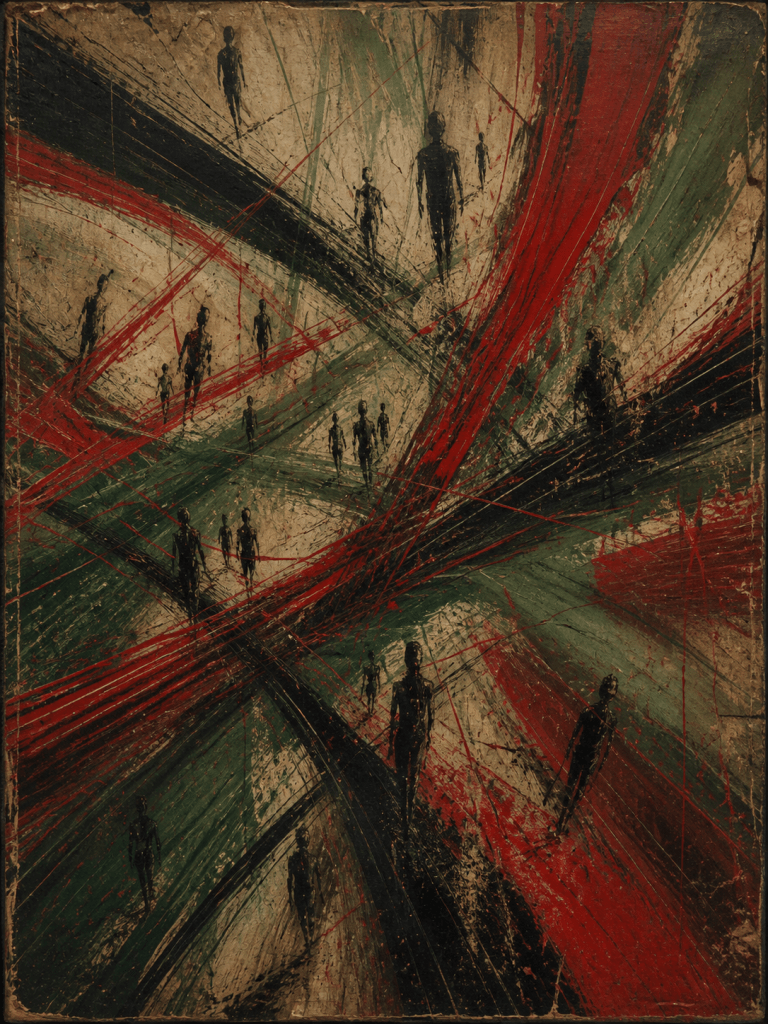
I wrote “Leading Lines” when I was 34, back when everything still felt like it had a question mark behind it. Listening now at 52, I hear that younger version of me wide open to the world with no filters, no calluses yet—letting sound, light, and people’s humanity hit me full force. That’s what this song is. It’s a map drawn in pencil, not ink. You can hear me trying to understand why a melody can break you, why a stranger can change you, why some people walk away like they’re following something you can’t see.
There’s a kind of innocence in it I don’t think you get that innocence back, but I’m glad I captured it when I did. I didn’t try to be clever. I just stayed honest—questions stacked on questions, no real answers, just movement. Even now, I don’t think the questions changed all that much. Maybe I just stopped voicing them.
Lyrics:
Verse 1
Always been affected by everything around me
Don’t be surprised, it’s how I’ve chosen to be
See this may be my last trip, now 34 around this star
I love to ask why it is, things are the way they are
And I’m ok with whatever answer
I’ll process it all the way I always do
With kindness and understanding
a better way to relate to you
Chorus
but, Why do sad songs make me sad
Why do angry songs make me mad
Why do people choose to leave
What are the (leading lines) they see
Which voices will they follow
Which are the voices they believe
Verse
I am affected by sounds around me
They make me fear, they make me love, make me believe
While most learn to ignore them
To me they make me feel complete
Can we speak a second about light
And how it lays across a skin
Can change you heart in an instance
But only if you let it in
Chorus
Like, why do sad songs make me cry
Why do swing songs make me move
Why do strings make feel like I can fly
Why do blues song’s make me blue
Why is it lovers always lose
Why does real love never seem to choose
Bridge
And all the time we take
to ignore the things right in our face
are moments that we lose, I don’t like to lose, I really don’t like to lose
[chorus]
Ohhh, Why do sad songs make me sad
Why do angry songs make me mad
Why is it people choose to leave
What are the (leading lines) they see
Which voices do they follow
What are the voices they believe
Outro
(What are voices you believe)
(What are the voices we believe)
(What are voices you believe)
(What are the voices we believe)
Something new to listen to:
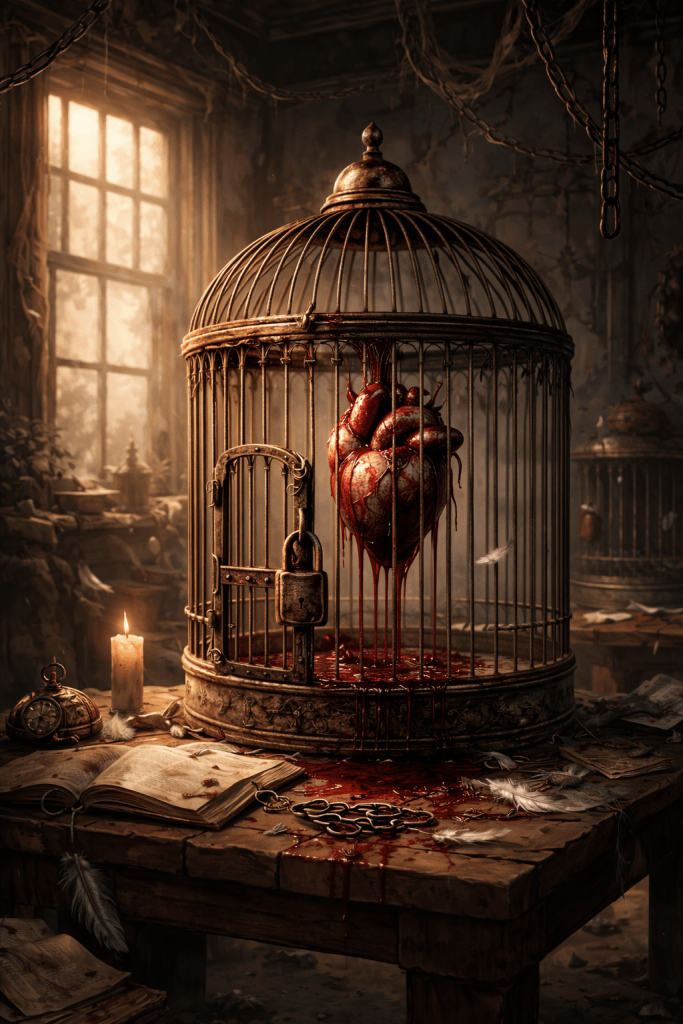
“Faith Today” is my attempt to take an unsparing look at a world where people don’t just accept control, they choose it. I stripped everything back on this one, both musically and vocally, because it didn’t need polish—it needed perspective. There are no heroes here, no simple answers, just the quiet ways we build our own cages in the name safety. This song sits in that tension between belonging and freedom, and what it costs to hold onto either. I’m not trying to resolve it—I’m just asking the question I can’t seem to shake: who are we supposed to be?
LYRICS:
[Verse 1]
Every smile seems so rehearsed
Every sleeve hides a chain
Everyone swears they’re hurting
But they’re all just trading in pain
Little screens, little badges
Little keys to the little cages
Say they all hate the script they’re reading
But still they’re begging for the pages
[Chorus]
I’m losing faith in everyone around me
All of em’ either captured or looking to be
Tie their own ropes, call it security
I’m losing faith in everyone around me
And I’m not sure who I’m allowed to be
[Verse 2]
Watched my brothers fold their anger
Into something they could sell
Watched my sisters dim their light
Until it only lit the cell
Every rebel drinks the koolaid
If it comes in a pretty glass
Raise a toast to being “chosen”
While knives slide into their back
[Chorus]
I’m losing faith in everyone around me
All of em’ either captured or looking to be
Sign their own names on the guarantee
I’m losing faith in everyone around me
Still not sure who I’m allowed to be
[Bridge]
Did I miss the moment where I gave in?
How’d I learn to love a leash?
If I stand alone, is that freedom
from a world that’s out of reach?
[Chorus]
I’m losing faith in everyone around me
All of em’ either captured or looking to be
Build their own walls and call it sanctuary
I’m losing faith in everyone around me
Maybe we’ll never know who I was supposed to be
Maybe I’ll never know who I was supposed to be
Who are we supposed to be?
Who are we supposed to be?
We’re not living through collapse. Though we are living through something.
We’re living through shared disorientation and fragmentation.
An executive thought: The individuals who’ll matter most in the years ahead won’t be those with the most information, but those who can:
I. A Misdiagnosis of “Bad Times”
The common framing suggests a cyclical decline:
strong men create good times → good times create weak men → weak men create bad times
While compelling, this model oversimplifies that reality.
By most material measures, modern life isn’t defined by collapse:
Yet despite this, there’s a widespread sense of instability–as if war, struggle, genocide and slavery are a new concept we collectively have never experienced before.
This isn’t a contradiction. It’s a shift in the nature of difficulty.
We’re not facing systemic ruin.
We’re facing cognitive and cultural overload.
II. The Age of Disorientation
The defining condition of the current era isn’t scarcity—it’s excess:
Humans evolved to operate within:
Today, those constraints have dissolved.
The result is:
In this environment, individuals aren’t under-informed.
They’re under-oriented.
III. Reframing Strength
In prior eras, strength was often expressed physically or through endurance under material hardship.
Today, the arena’s shifted.
Strength is no longer defined primarily by survival under scarcity, but by stability within excess.
The modern “strong man” possesses:
1. Clarity under pressure
The ability to make decisions without perfect information.
2. Internal discipline
Independence from constant external validation or consensus.
3. Responsibility orientation
A tendency to move toward burden, rather than avoid it.
4. Anchored meaning
Commitment to something larger than self—family, mission, principle.
5. Emotional regulation
The capacity to act without being ruled by impulse or reaction.
These aren’t inherited traits.
They’re developed—often in opposition to the surrounding environment.
IV. The Nature of Modern Weakness
Weakness today isn’t best understood as moral failure, but as structural erosion.
It presents as:
These traits aren’t accidental.
They’re reinforced by systems built on:
The environment conditions the outcome.
V. The Core Threat: Loss of Shared Orientation
The greatest risk isn’t that individuals become weaker.
It’s that societies lose:
When these degrade, cohesion fractures.
Bad ideas aren’t dangerous solely because they’re incorrect.
They’re dangerous because they destabilize collective meaning.
A materially strong society can still become fragile if it loses its ability to agree on reality.
VI. The Emergence of the “Next Form of Strength”
History suggests capable individuals emerge in response to instability.
However, they won’t mirror the past.
The next generation of strong individuals will be those who can:
Their defining trait won’t be dominance, but orientation.
They’ll create order where there’s noise.
VII. Operationalizing Strength
This form of strength isn’t theoretical. It’s practiced daily.
It rests on three disciplined capabilities:
1. Deciding what matters
Clarity begins with constraint.
At any given time, only a few domains warrant sustained attention:
If these aren’t defined internally, they’ll be defined externally.
2. Ignoring what doesn’t
In an attention economy, ignoring is an active skill.
This requires:
The defining phrase of modern discipline is:
“This isn’t mine to carry.”
3. Acting with clarity anyway
Certainty is increasingly rare.
Effective individuals don’t wait for perfect information.
They act based on principle and adjust as needed.
This requires:
VIII. The Cost of This Path
This mode of operating carries tradeoffs:
However, the return is significant:
IX. Conclusion
The question isn’t whether the next generation will produce “strong men” in the traditional sense.
The question is whether individuals will develop the capacity to remain oriented in a world designed to fragment attention and meaning.
Those who can:
They won’t just endure the current era—they’ll shape what comes after.
Strength, in this age, isn’t brute force.
It’s clarity, discipline, and direction under conditions of constant noise.
I wrote this song about 15 years ago after realizing how much of my life I’d spent learning how to blend in. Read rooms. Match pace. Know when to agree, when to disappear, when not to ask hard questions. The starlings are a metaphor for that, a metaphor for how moving together can feel like safety and not having to decide can feel like relief. There’s a cost to that comfort. You can stay in motion long enough to forget what you actually want and who you really are, or where and when you need to land. This song isn’t about rejecting people or community; it’s about noticing the moment when belonging starts to erase you and you begin to wonder what it might take to find the ground again.
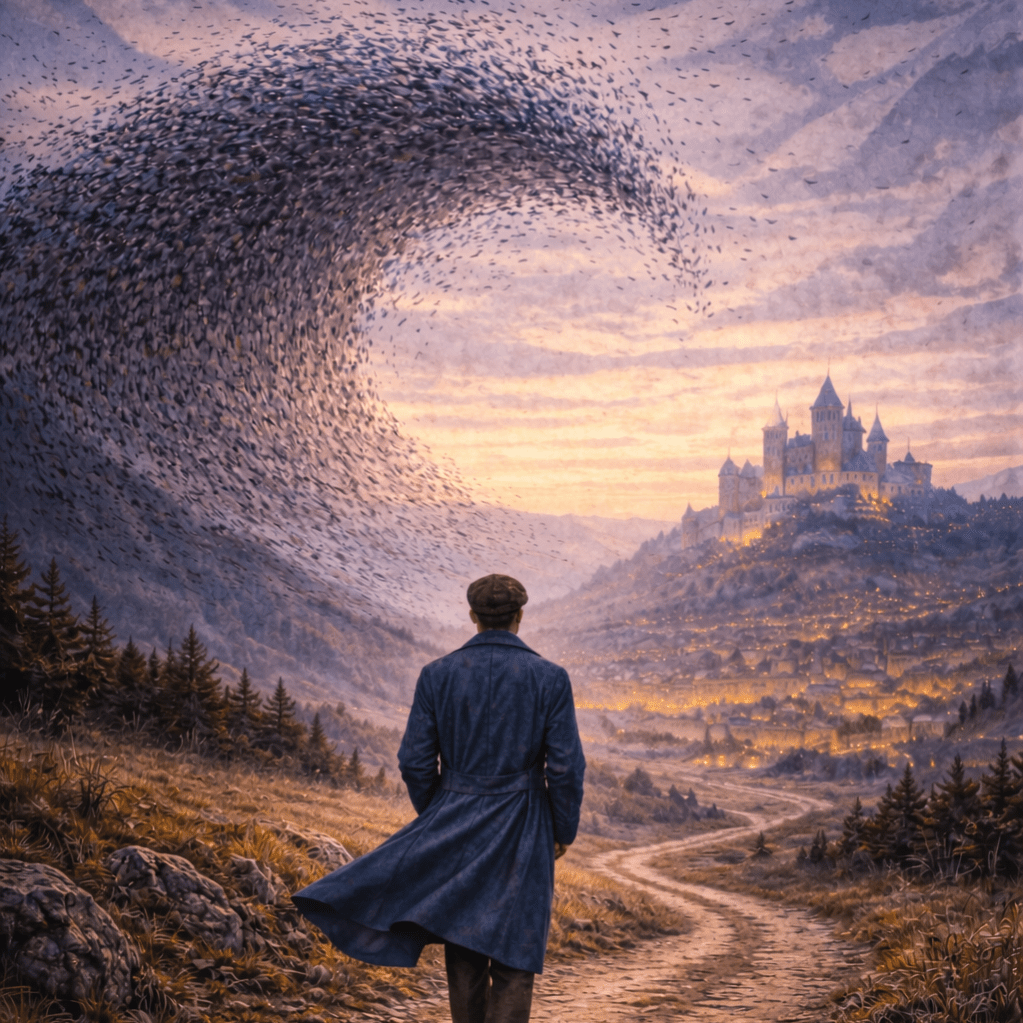
SONG: Where the Starlings Fly
Verse
I learned early how to listen
To the sound and pace of lies
How to turn before the panic
How to read the shifting skies
I kept em’ close enough for comfort
close enough to disappear
And every time I felt uncertain
I’d just follow what was near
Chorus
Way up there, where the starlings fly
Where the air ‘s so thick with sound
Every turn already chosen
Every fear already drowned
There’s a safety in the numbers
And a beautiful blur to lines
I’ve lost myself a thousand times
Up where the starlings fly
Up where the starlings fly
Verse
I learned young and quickly
Just how to read a room
learned the rhythm of agreement
when to try and when to lose
sadly, mistaking motion for progress
you know, Moving quick always has a cost
but keeping pace without direction
is the easiest way to get lost
Chorus
Way up there, where the starlings fly
Where you could never be alone
And no one breaks formation
the crowd around you feels like home
With No decisions to be made
Movement’s progress becomes a lie
I’ve lost myself a thousand times
Up where the starlings fly
Bridge
Well you never stopped to ask
What you’re moving from or toward
and you’ve traded all your wanting
For the comfort of a swarm
Chorus
Way up there, where the starlings fly
Where you will never be alone
And no one breaks formation
the crowd around you feels like home
With No decisions to be made
Movement’s progress becomes a lie
I’ve lost myself a thousand times
Up where the starlings fly
But some truths don’t survive a crowd
And you long to find the ground
Up where the starlings fly,
up where the starlings fly.
The Suno Version:
The Original Version:
I called this work, “the carriage.” It is about a lifelong confrontation with an unseen control system. The forces that claim authorship over our lives. It’s about living just outside the architect’s clean lines, believing you were meant for something you created, only to realize something else has been keeping score the whole time.
The narrator isn’t a savior or a friend. He’s the arbiter; the accountant of time and intention. While you were dreaming, creating, laughing, trusting yourself, he was building the world around you. Every gift was a loan. Every moment came with interest.
The song asks a quiet and dangerous question: when you close your eyes and imagine freedom, what are you really doing with it? Are you building something that lasts, or just running until the walls appear?
This is a story about control disguised as order, fate disguised as fairness, and the moment you realize the blueprint was never yours.
I have posted my original version recorded about 2 years ago and the Suno version. I like them both, but the Suno version added some anger I don’t think I could express. If you have time, listen to both and let me know what you think!
LYRICS:
[Verse 1]
You got big dreams, boy
See, I got other plans
You can keep on runnin’, but one day you will dance
To the beat that I stir
The beat I create
I’ve givin’ you time
Now it’s my time to take
[Chorus]
It just keep on runnin’, boy, as fast as you can
You got ideas and I got real big plans
This great big world you let just slip right past
And I’ll just keep takin’ ’til you understand
That your tears are like wine
That console my ache
Of disappointing choices that you continue to make
I’m gonna catch you, gonna drop you to your knees
I’m the architect, you do as I please
[Verse 2]
the arbiter between what’s real and what’s fake
What you get right and what you mistake
What you can see and what you believe
What’s really there and what is a dream
[lead guitar]
[Chorus]
I ain’t no friend
I ain’t no saint
While you believed in miracles, I built this place
I’ve given you gifts, I’ve given you time
You used it for fun, now those gifts are mine
I ain’t no friend
I ain’t no saint
You believe in miracles, I’ll build this place
I’ve given you gifts, I’ve given you time
You used it for fun, now those gifts are mine
I ain’t no friend
I ain’t no saint
You’ll believe in miracles, while I built this place
I’ve given you gifts, I’ve given you time
You used it for fun, now those gifts are mine
I ain’t no friend
I ain’t no saint
You’ll believe in miracles, while I built this place
I’ve given you gifts, I’ve given you time
You used it for fun, now those gifts are mine
Wrote this tiny little essay in my Sophomore year Philosophy Course. Enjoy, or hate it.
We like to say we love people. Bodies. Names. Faces. But if we’re honest—brutally honest—those are just the containers. What we love is never the carbon itself. We love what happens inside and beside it. The way time behaves when someone is near. The feeling of being known and knowing (trust). The brief and absolute suspension of loneliness when that other consciousness overlaps our own.
Nobody aches for bone and tissue.
We ache for moments.
When someone leaves our life, we don’t miss their skin or their weight or even the details of their fingerprints. We miss the feeling of their skin, their weight. The sound of their laugh in a moment—or a thousand moments all at once. That’s what hurts most: not the loss of a person, but the loss of access to a version of ourselves we only became in their presence.
Humans treat love as property—as if someone can be owned emotionally the same way a old chair or a house can be owned physically. But intimacy isn’t a possession. It’s an event. And events end. The tragedy isn’t that people die or leave. The tragedy is that moments never remain still long enough for us to notice we’re inside them until they’re already past.
When we meet someone, they always ask where you’re from or where you’re going.
No one ever asks, “Who are you right now?”
Memory is the real wound. Not abandonment. Not distance. Memory is proof that something happened once that no longer exists. Every ache is simply time reminding us that it only moves forward—and in the spirit of Anna Nalick, “the hourglass is still glued to the table.”
We often say heartbreak is about someone else—but it isn’t. It’s about ourselves. It’s grief over losing who we were while someone was around. That version of us becomes unreachable without them. Not dead—just sealed off in time, like an old room we no longer enter.
People confuse longing for a return of themselves with wanting another person. What they really want is the weather of those years. The emotional climate. The familiar gravity. The internal rhythm that existed then, but is unreachable now. No one wants their ex back. They want their nervous system back. They want what once felt like simple mathematics.
We believe love must be eternal because we cannot tolerate how temporary it actually is. But fleetingness is not a flaw. It’s the entire meaning. If moments were permanent, there would be nothing sacred about them. The reason a touch matters is because it ends. The reason a voice cuts through us is because one day it will never reach us again.
Everything worthwhile decays. That doesn’t invalidate it.
It proves it was real.
We don’t mourn people.
We mourn time that will never happen again in the same way.
And calling that “love” is the most honest and comforting lie humanity ever invented—
because the truth would be too clean, too cold, and too piercing to survive.

