• Ya know relationships are hard. What’s even harder is taking all the things you feel relative to a relationship and expressing them in one salient little tune. I penned this little tune sometime around the early-2004 timeframe just after a nasty little breakup. I pressed record, picked up a guitar and sang it through once. Found it the other day looking through my files and archives. Man I was angry at that point in my life. Suno did it justice, sounds exactly like I would have recorded it.

    Verse 1

    My friends say life shouldn’t be that hard

    I told em’ to spend some time with you

    Baby, tell me one last time how worthless I am

    ‘Cause I don’t think it’s getting through

    I am done with this life

    Was trapped inside your hell now I’m on the other side

    No more always being wrong

    No more hateful woman to ignore my songs

    Chorus

    And there will come a day you’ll find yourself alone

    That day will come sure as the cold wind blows

    And there will come a day when you will lose it all

    And I finally get to watch you fall

    And I finally get to watch you fall

    Verse 2

    It’s not that I hate you, or mean you any pain

    See I got these nightmares that will not go away

    You took a hammer to my CDs, threw my glasses on the floor

    ain’t nothing left in here, worth fighting for

    We had these big dreams back in nineteen ninety three

    We’d build a life together, raise a family

    I guess things change in life, and people lose their way

    Hard to move on, so bogged down in yesterday

    Chorus

    And there will come a day you’ll find yourself alone

    That day will come sure as the cold wind blows

    And there will come a day when you will lose it all

    And I finally get to watch you fall

    And I finally get to watch you fall

    [lead]

    Bridge

    There are those who’s death will cause you pain

    Others leave you wishing for just another day

    Some leave you glad they finally found escape

    But you, I can’t wait. I just can’t fucking wait, because…

    Chorus

    there will come a day you’ll find yourself alone

    That day will come sure as the cold wind blows

    And there will come a day when you will lose it all

    And I finally get to watch you fall

    And I finally get to watch you fall

    Chorus

    And there will come a day you’ll find yourself alone

    That day will come sure as the cold wind blows

    And there will come a day when you will lose it all

    And I finally get to watch you fall

    And I finally get to watch you fall

  • We all usually end up relating to each other through need. It’s pretty rare to meet someone who feels whole and comfortable in their own space—someone who connects just out of curiosity or genuine interest. That idea feels even more true today, in a world that often runs on scarcity and longing.

    I was thinking about this the other day and remembered the book by Shel Silverstein that really stuck with me: The Missing Piece. I wrote this song about 22 years ago, and honestly, it reflected most of the relationships I was in back then—ones built on the foundations of need. That book might be one of the most quietly powerful works I’ve ever read and it deeply influenced this song.

    There are so many ways to take The Missing Piece in. You can see it as the frustration of never finding the “right” missing piece and settling for less… or you can see it as learning to smooth your own edges and discovering how to roll on your own. Either way, if you haven’t read it be ready to be affected.

    Verse 1

    I stitched my soul into your frame,

    Borrowed your laughter, gave you my  name,

    Just a stranger in your crowded room,

    Chasing shadows, hiding all the gloom.

    Wanted to live in your skin a borrowed me,

    world fell apart  before I could see

    that to view your light, had to dim my own,

    Two strangers dancing, song unknown.

    Chorus

    It’s not my fault that the pieces stay apart,

    We were searching blind, two lonely hearts.

    You can’t force a fit when it will not go

    Needed to know that this was real, not just a show 

    Sorry, I’m not the echo you thought I’d be,

    That I found my voice, and set myself free.

    From a missing piece to a soul that grows,

    Full human now, not someone you’d want to know 

    Verse 2

    I mirrored your steps, a hollow path,

    Lost in your world, lost myself too fast

    A drifter clinging to your warm embrace,

    But love needs roots, not just time and space.

    We offered hunger, with nothing to share

    Two souls adrift, gasping for air,

    Relating from need, not from the core,

    Two halves pretending, but needing more.

    Bridge

    No blame to hold, no guilt to bear,

    We were both lost, needing repair.

    You gotta find your heart, your own true song,

    Before you bend into where you don’t belong.

    A missing piece learns to stand alone,

    Builds its life, carves its own.

    Chorus

    It’s not my fault that the pieces stay apart,

    We were searching blind, two empty hearts.

    You can’t force a fit when it will not go

    Needed to know that this was real, not just a show 

    Sorry, I’m not the echo you thought I’d be,

    That I found my voice, and set myself free.

    From a missing piece to a soul that grows,

    Full human now, not someone you’d want to know 

    Chorus

    It’s not my fault that the pieces stay apart,

    We were searching blind, two empty hearts.

    You can’t force a fit when it will not go

    Needed to know that this was real, not just a show  

    Sorry, I’m not the echo you thought I’d be,

    That I found my voice, and set myself free.

    From a missing piece to a soul that grows,

    Full human now, not someone you’d want to know

  • This was a short story written back in 1998 for an English course I was taking during work on my bachelors degree. I always loved the story. I got an A+ on it.

    I also turned the story into a song:

    Title: Ella (love was a long road once)

    Artist: One of Jason August’s Many AI Personas

    Scene 1

    The wipers dragged rain across the windshield in slow, tired sweeps. The coffee had gone cold half an hour back somewhere near Baltimore, and he finished it anyway. Road signs floated out of the wet dark like ghosts—PENNSYLVANIA STATE LINE 56 MILES. He reached down to the dusty floorboard for the map he didn’t really need. The night was cold and strangely bright with mist, and the heater in the old Plymouth was the only thing keeping his hands warm and steady.

    By the time he hit York, he had folded and unfolded the same scrap of paper so many times it had the softness of cloth. One hand held the wheel as the other clenched the paper. He watched the drifting lights of passing cars—going somewhere, belonging somewhere. The northbound lanes were empty, all except for him.

    A little Spanish radio station crackled through the static. The music was thin, tinny, full of longing. He let it play. He read the numbers again.

    Ella—224-1623.

    He mouthed the name like a prayer.

    “You’ll burn a hole through the floor doing all that pacing, Ella,” her mother said.

    Scene 2

    “Oh, Mother, I don’t know what to do. He’ll be here in two hours,” Ella said, chewing at a nail, shoulders tight.

    “Come sit. Have some of my soup. It’ll settle you.” Her mother’s kidney bean soup had won Best in County last year. It wasn’t the beans—it was the way she seasoned them before they ever met the broth.

    Clippings and newspapers were spread across the kitchen floor like leaves. Her mother never threw away a coupon she thought she could use. One headline caught Ella’s eye:

    SCRANTON TRAIN SCHEDULE DELAYED BY FREEZING WEATHER.

    Her stomach tightened. The spoon felt heavy in her hand. She could feel her heartbeat inside her own mouth.

    “Ella, you’ve hardly touched—”

    The phone rang.

    “I’ll get it,” Ella called, though her mother was already halfway across the room.

    “Sit,” her mother said, firm.

    She lifted the receiver. “Hello?”

    A voice—quiet, shaking—“Is Ella there?”

    “No, she went out with friends,” her mother lied, eyes fixed on her daughter. “Who’s calling?”

    “Just… tell her James called, please.”

    “I’ll tell her,” she said, hanging up before he could say anything else.

    Scene 3

    The Plymouth’s engine caught, sputtered, settled. He leaned his forehead against the steering wheel. His hair dripped rain onto his jacket. Every muscle in him pulled tight like wire.

    Seven months. Seven months of talking to her memory like it was still alive somewhere. He had met her in an all-night diner, the kind where truckers sit with their heads down. It was her eyes that did him in. Eyes that never saw themselves as beautiful.

    She would never hurt anyone, he thought.

    He drove.

    Thirty minutes later, tears came the way rain comes—first nothing, then everything.

    “How could she just go out with friends,” he said, trying to steady his voice into something like manhood.

    Scene 4

    “He doesn’t call for seven months and he thinks he can walk back into your life?” her mother said, cigarette smoke drifting from her hand like punctuation. “He’s no good, Ella. You don’t need him.”

    “But Mother—”

    “No ‘but.’ You want trouble, that’s how you get it.”

    Her mother went to the porch for her nightly drink, and Ella was alone with the rain tapping at the window. She touched the strands of her long blond hair. The clock on the wall ticked softly.

    He would be in town now.

    She curled her hand over her stomach. Two months more and everything would be different.

    Scene 5

    He dug through his pockets for dimes, quarters—anything. A few coins hit the pavement. He let them fall. The payphone booth was cold against his back as he dialed.

    The city lights of Scranton glowed through fog like a promise that had forgotten itself.

    The line rang.

    “Hello?” Ella whispered. She knew who it was.

    “Oh God, Ella,” James said, voice torn open. “There’s so much I need to tell you. I’m at the little diner. Please—come see me.”

    She closed her eyes.

    “I’m sorry, James,” she said softly. “I’m going out with friends. I have to go now. Goodbye.”

    The phone slipped from her hand and rested against her stomach.

    James sat in the mud off the highway, looking at the glow of the city and the dark shape of the mountains rising behind it. His jacket lay beside him. When he’d thrown it, his bag had opened and papers had slid free.

    James S. Matthew is hereby released from the Florida State Penitentiary on this day April 12, 1967.

    He stared at the words until they stopped meaning anything.

    The night was quiet. Rain softened to nothing. Crickets started their song.

    There was a single loud crack.

    The crickets paused.

    Then continued.

    The revolver lay in the mud beside him.

    And the sky did nothing at all.

    Scene 6

    Six weeks before the due date, the morning light came in thin and gray through the kitchen window. The rain had stopped sometime before dawn, but everything still seemed wet and quiet. Ella sat at the table, a soup pot still on the stove from the night before, though neither she nor her mother had eaten.

    She watched her mother smoking through the window, but her attention drifted to the front door where the mail slot had clattered an hour earlier.

    Ella finally rose, slow and heavy, one hand instinctively resting on her stomach. The baby moved—a flutter, a shift—like someone turning over in sleep.

    A thin stack of mail lay on the mat. A bill, a coupon circular, and a newspaper.

    She sat back down and unfolded the paper. Near the bottom of page six, half-hidden by advertisements for lawn seed and auto parts, there was a short article:

    WAYWARD SON FOUND DEAD NEAR SCRANTON HIGHWAY

    James S. Matthew, 27, of Jacksonville, Florida, was discovered early Thursday morning near a roadside turnout…

    Her eyes moved down the page.

    Matthew had recently been released after serving six months for the death of his stepfather, Robert C. Lanning, during a domestic altercation in which Matthew intervened while Lanning was reportedly striking Matthew’s mother. The judge noted the act appeared driven by defense rather than malice. He died of a single self-inflicted gunshot wound.

    No photographs.
    Just facts.
    The world’s version of a life.

    Ella offered the paper to her mother.

    Neither spoke.

    Only the refrigerator hummed.

    Finally, Ella said, “He didn’t leave us. He was coming home.”

    Her mother closed her eyes. She had never known how to love—only how to fear, and how to want. It sat heavy in the room between them.

    Ella folded the paper carefully, pressing the crease flat with her palm. Not clutching it. Just making it neat. Making it real.

    She set it beside her bowl of untouched soup.

    Outside, the clouds thinned enough for a small line of sunlight to touch the kitchen floor.

    Ella rested both hands on her stomach, holding it the way one holds something precious, something breakable, something that must be carried differently.

    The house was quiet.

    And in that quiet, she whispered:

    “I’ll tell her about you.”

    The baby moved in answer.

    Abstract/Thoughts:

    In the 1960s, distance took on a different weight. There were no screens to collapse miles, no instant clarifications at the tap of a finger. If someone left town, you waited for a letter, and that letter might take days, and in those days the mind did its own traveling. A person’s word had to stretch across highways, across county lines, across seasons. Trust lived in the spaces between postcards, in the long quiet before the telephone finally rang.

    People carried each other in memory—whole and intact, or changed in ways they couldn’t yet prove. The world was smaller in what you could know, and larger in what you were left to imagine. And in that space of unknowing, love could grow or fray—quietly, invisibly—until the day someone returned, or didn’t.

  • Prison Planet by: Jason August

    Performed by: one of my many AI personas. Every body loves them some AI but every body hate to compete with it.

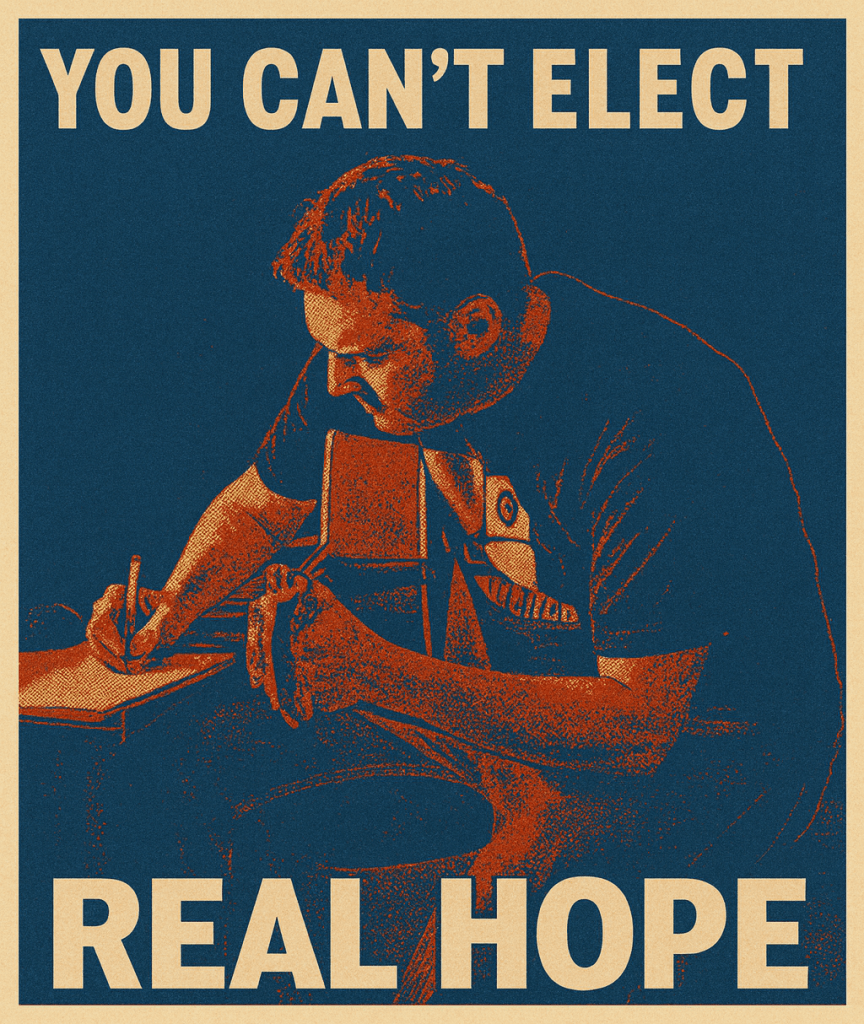
    And yep, that’s a good old war-poster style image of me shooting medium format film. Nope, I am not that cool. It was a failed experiment I looked cool attempting

    Livin, lovin, doing time with you down here on this prison planet. Grab your coffee, grab your camera, grab you guitar grab your sense of adventure. I’m gonna tell you some stories and lie with a straight face up in this place.