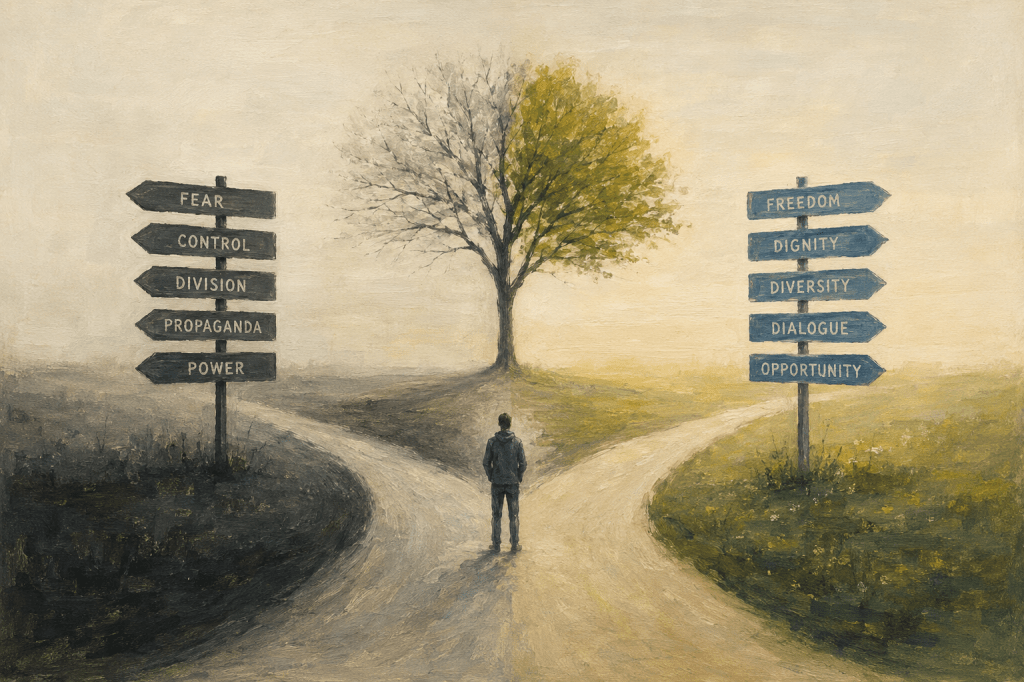
When the Revolution Met the Human Being
An essay by Jason August on the fundamental differences between Communism and Liberal Democracy framed around the use of active measures to undermine the beauty of liberal democratic systems.
I started thinking this evening about Soviet Active measures (aktivnye meropriyatiya) after reading Tomas Rid’s book of the same name, a few months ago. My questions underneath the thoughts turned out to be much larger.
Why would a state attempt to sell, or even indirectly impose upon others, a system that was visibly failing within its own borders? At what point did Soviet leaders understand that the society they had built did not resemble the society they claimed or desired to have built? Why, once they understood that, did they continue trying to convince the world that their system was superior, or did something darker happen? Did the objective gradually change from believe what we believe to how do I stop you from believing in what you believe?
That question led me backward, toward the premise underneath the Soviet experiment itself.
The Soviet project was not simply an attempt to redistribute wealth. At its most ambitious, it attempted to change the material relationships among people.
That distinction matters.
Marxism proposed that much of what we think of as human behavior is produced by material circumstances. Owner and worker, landlord and tenant, rich and poor, creditor and debtor—these relationships do not merely distribute resources. They shape the people living inside them. Competition, alienation, exploitation and class consciousness arise, at least substantially, from the organization of material life.
Change those relationships, therefore, and perhaps we change ourselves.
There is something compelling in that idea because some portion of it is obviously true. Human beings behave differently under different incentives. Scarcity changes behavior. Abundance changes behavior. Institutions shape expectations. Culture establishes what is honorable, shameful, ordinary or unthinkable. A child born into a feudal society understands his possibilities differently from one born into a modern liberal democracy.
But the Soviet experiment encountered a problem… Human beings came with it.
Eliminate private ownership and people still seek status. Suppress markets and exchange does not disappear. Remove wealth as the principal currency of privilege and access itself becomes valuable. Political position becomes a kind of property. Relationships become a kind of market. Proximity to power becomes capital.
The hierarchy did not disappear.
It changed currency.
That realization leads to a question that extends far beyond communism:
How much of the human being is created by the system, and how much of the system is created by the human being?
Every political and economic system develops a distance between what it claims to be and what the people operating it know it actually is. That is not uniquely Soviet. Corporations do it. Governments do it. Militaries do it. Religions do it. Liberal democracies do it.
The people nearest the machinery almost always understand its contradictions better than the people looking at the machinery from outside.
What made the Soviet contradiction particularly severe was the magnitude of its claim. The system did not merely promise better government. It claimed to have identified the historical forces producing exploitation and hierarchy and to possess a means of overcoming them.
Yet hierarchy returned.
Privilege returned.
Self-interest returned.
Favoritism returned.
Parents still wanted advantages for their children. Officials still wanted better apartments. People still wanted security, recognition, comfort, influence and access.
The revolutionary may have believed that he was sacrificing himself for a society that had not yet arrived. The next generation could tell itself that the system was imperfect but worth defending. Eventually another generation could simply understand how the machinery worked and make the accommodations necessary to live inside it.
Perhaps nobody needed to announce:
We don’t believe anymore.
Belief could simply become ritual.
Attend the meeting. Repeat the language. Display the symbols. Produce the numbers. Protect your position. Help your family. Don’t ask questions whose answers everyone already understands.
This is where the Soviet story becomes more interesting to me than the simple declaration that “communism failed.”
Perhaps the deeper failure was mistaking a theory of human behavior for a theory of human nature.
Material conditions unquestionably influence us. But the Soviet experiment suggests that there are persistent human impulses capable of surviving enormous changes in material conditions. Ambition, loyalty, envy, generosity, greed, love, tribalism, fear, competition, status-seeking and the desire to give our children advantages do not necessarily disappear when the economic vocabulary surrounding them changes.
They find another outlet.
And the cost of discovering this was not academic.
Millions of people died under the Soviet system through political terror, execution, forced collectivization, famine, deportation, imprisonment and the Gulag. Any examination of the Soviet experiment that becomes fascinated with the theory while allowing those people to disappear into abstraction commits another kind of error.
Because there was a terrifying possibility contained within the attempt to remake society.
Begin with:
Human beings are shaped by their circumstances.
Move to:
We must change their circumstances.
Then:
Some people are preventing that transformation.
And eventually:
Those people are standing in the way of history.
Once human beings become obstacles to an imagined historical destination, extraordinary cruelty can be reframed as necessity.
That progression was not philosophically inevitable, but historically it happened.
And after all that coercion, the new human being still did not arrive.
People rebuilt hierarchies.
They created informal markets.
They accumulated privileges.
They cultivated relationships.
They protected their families.
They pursued status.
The state could change the rules governing human interaction, but it could not simply manufacture the human being its theory required.
That brings me back to active measures.
What happens when the people operating such a system begin to understand its contradictions?
Early revolutionary ideology could genuinely proclaim:
Our system represents the future.
But maintaining that confidence becomes increasingly difficult when the people making the proclamation can see shortages, privilege, corruption and stagnation around them.
At some point the easier argument becomes something different:
Your system is fraudulent too.
That is an extraordinarily important transition.
You no longer need to convince an American that Soviet communism is superior. You only need to convince him that his own institutions are illegitimate.
Find the genuine contradictions.
America has plenty.
Race. Wealth. Inequality. War. Political corruption. Hypocrisy. Corporate influence. Class. Religion. Immigration. Regional differences.
You don’t necessarily have to invent the wound.
You can simply keep touching it.
And perhaps this is where the psychology of the late Soviet system becomes relevant. A ruling class that had watched belief deteriorate inside its own society would have possessed intimate knowledge of something extraordinarily powerful:
Institutions depend upon people continuing to believe that participation is worthwhile.
That lesson survives communism.
Modern authoritarian influence does not necessarily need to offer an alternative political philosophy. It can accomplish something by producing exhaustion, cynicism and distrust.
Everyone lies.
Everything is corrupt.
Nobody earned anything.
The system is rigged.
Nothing you do matters.
There is no truth, only competing narratives.
That is different from saying become like us.
It says:
Stop believing you can be different from us.
And here is where liberal democracy has to resist the temptation to congratulate itself.
Capitalism and democracy do not and cannot solve the problem of human nature either. Wealth becomes power. Institutions protect themselves. Markets become captured. Families transmit advantage. Bureaucracies perpetuate themselves. Successful people can mistake the advantages they received for evidence of merit. I typed that through a giggle.
Our hierarchy can change currency also. The difference worth protecting may therefore be more modest than claiming that we discovered the perfect system.
Perhaps the achievement of liberal democracy is that it does not require a perfected human being.
It assumes that people will seek power and therefore divides power. It assumes that leaders may become corrupt and therefore makes them removable. It assumes disagreement will persist and therefore creates mechanisms for disagreement that do not require eliminating the person on the other side. It allows property but attempts to constrain what property can purchase politically. It protects individual ambition while acknowledging that one person’s ambition can threaten another person’s liberty.
It doesn’t eliminate the human problem. At its best, it contains the human problem.
And perhaps individual opportunity is more important psychologically than I had previously considered. A person does not have to become wealthy to believe that his choices matter. He needs some credible reason to believe that his position is not completely predetermined—that he can build something, leave something, criticize something, change professions, create, fail, recover, move, speak, dissent, or give his children possibilities he did not possess.
The opportunity may be imperfect.
It may be distributed unfairly.
But belief in agency matters.
Which makes the most effective attack upon such a society surprisingly simple.
Don’t convince people that dictatorship is better.
Convince them that agency is an illusion.
Convince them that elections don’t matter, institutions cannot be repaired, achievement is fraudulent, truth cannot be discovered, everybody is corrupt and every apparent ideal is merely camouflage for somebody else’s pursuit of power.
Eventually people stop defending the imperfect institutions that allow them to change things because they have been persuaded that changing things is impossible.
And that brings the entire thought back to the human being.
The Soviet project tried to change material relationships in order to change humanity.
It discovered, brutally, that humanity also recreates material relationships in its own image.
Liberal democracy makes a different wager: don’t wait for better humans. Build institutions capable of surviving the humans we already are.
But that system contains its own vulnerability.
It survives only while enough imperfect human beings believe that, despite its contradictions, they retain some ability to act within it.
So perhaps the deepest contest was never communism versus capitalism.
Perhaps it was between two ideas about the relationship of the individual to the system.
One believed that changing the system could eventually transform the human being.
The other, at its best, assumes the human being will remain stubbornly human and tries to prevent any one of us–or any group of us–from gaining enough power to decide what everyone else must become, love, do, believe, etc….
That is a much less utopian promise.
After the twentieth century, I am beginning to think that may be precisely its virtue.


Leave a Reply