Friends, I know I don’t post as much as I should here. I spend most of my time at work and any free time with my family. I found over a recent trip to Africa and another trip to the UK time to reread Strauss’ and Howe’s book “The 4th Turning”. Then I went skateboarding this evening (always cleans the mind and soul for me). Had to type out my thoughts.
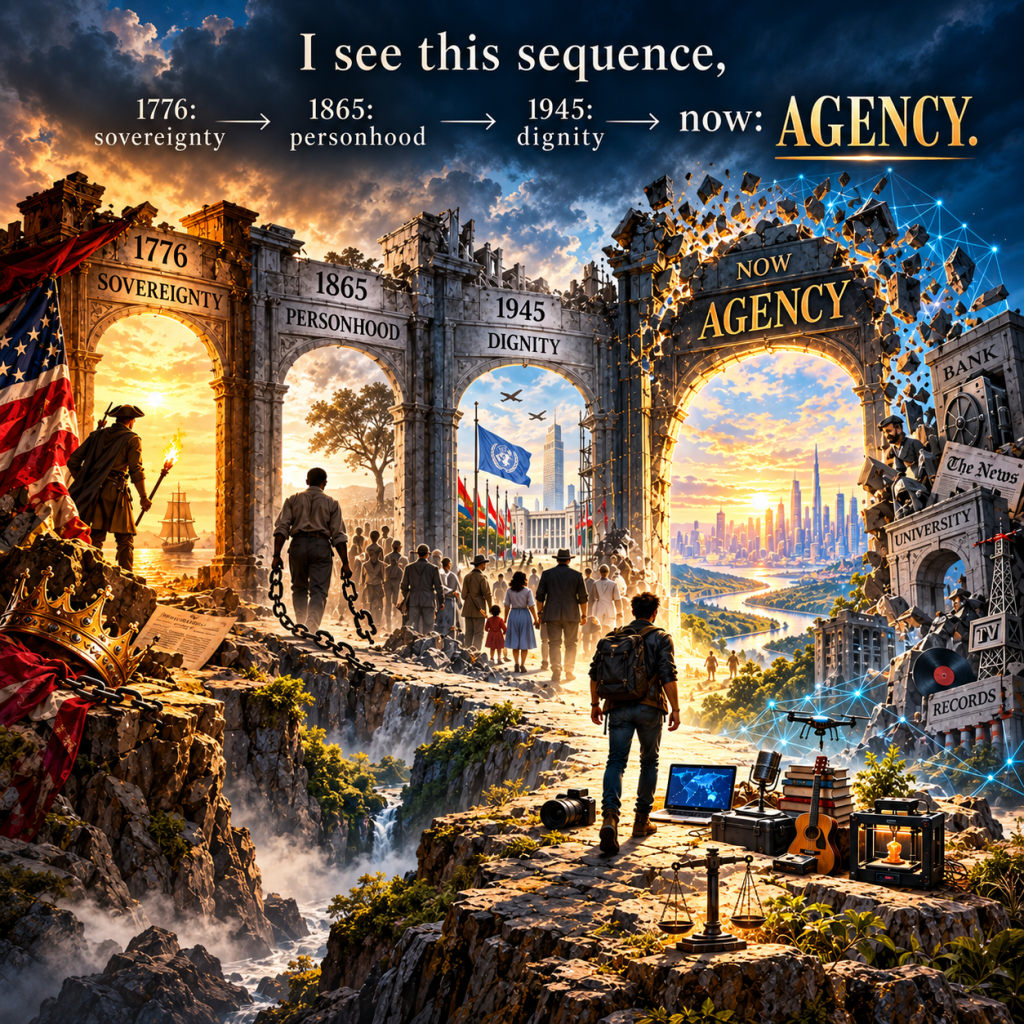
Will the 4th turning of this cycle be the: The Death of the Gatekeeper?
If we accept Strauss and Howe’s, Fourth Turning not as prophecy but as a useful lens, the pattern is striking: roughly once in a human lifetime, a crisis destroys an assumption/paradigm that had seemed permanent and replaces it with another. Strauss and Howe identify the Revolution, Civil War, and Depression/World War II as America’s great Crisis eras.
A perspective: each crisis isn’t merely political. It changed the definition of the individual.
1776 said: You do not belong to a king. The individual could possess their own sovereignty.
1860s said: One human being cannot belong to another. The individual could possess themself.
1940s said, imperfectly and absolutely incompletely: Human dignity cannot depend upon race, blood, nation, or inherited status. The postwar order increasingly made universal human rights–not merely citizenship–the moral language by which governments were judged.
So what dies next?
I suspect it’s the gatekeeper.
For most of modern history, individuals have required institutions to exercise meaningful power. Banks determined whether your idea received capital. Publishers determined whether you could reach readers. Record companies determined whether anyone heard your music. Universities certified knowledge. Newspapers determined what became public information. Governments issued currencies. Corporations owned the machinery necessary to manufacture things.
The internet began weakening this superstructure. Artificial intelligence will likely finish the job.
The next turning may therefore be about something deeper than left versus right, nationalism versus globalism, or capitalism versus socialism. I hypothesize it will concern individual agency versus institutional mediation.
A person can increasingly create music without a record company, publish without a publisher, manufacture without owning a factory, learn without attending a university, broadcast without owning a television station, build software without employing fifty programmers, and potentially conduct economic activity through networks that do not resemble twentieth-century banks.
This thought is enormously liberating and completely in every way, terrifying:
Institutions aren’t merely gatekeepers. They are filters. Editors reject nonsense. Banks absorb certain risks. Universities establish standards. Governments authenticate identities. Journalists decipher facts. Sometimes, so many times those institutions abuse their authority–but they also created a shared reality within which millions of strangers could cooperate.
So perhaps the coming crisis asks a more important question:
What happens when everyone becomes sovereign before we’ve figured out how sovereign people establish trust with one another?
The Revolution democratized government.
The Civil War ultimately democratized personhood.
The postwar settlement increasingly democratized dignity.
This turning may democratize power itself–the ability for a ordinary human to create, communicate, organize, persuade, manufacture, and participate at a scale once reserved only for institutions.
This thing being born may also resurrect something very old:
RESPONSIBILITY!
If there is nobody standing between the individual and enormous technological power anymore–we can no longer blame the king, the master, the institution, the editor, or the machine.
The strange destination of four centuries of self-determination may be discovering that the final burden of freedom is having no one left to hand your agency to. It’s yours, just yours
Perhaps, that would be a Fourth Turning worthy of the name.
Strauss and Howe themselves were careful about one important point: their framework proposed the rhythm and magnitude of crises more confidently than any prescribed outcome.
History doesn’t have to choose a particular future.
I see this sequence, 1776: sovereignty → 1865: personhood → 1945: dignity → now: AGENCY.
Would love some comments, did I miss the mark? If you’ve gotten his far lets chat…
Link to the book on amazon, was a great read:


Leave a comment